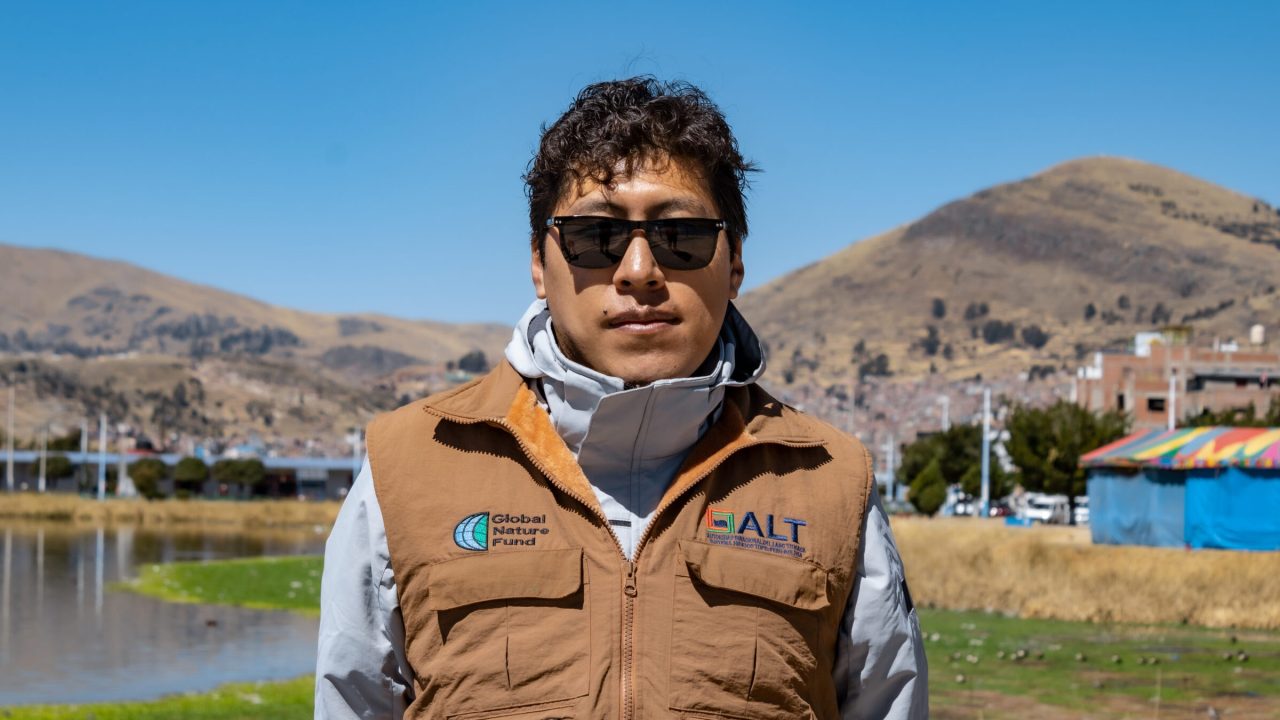
As part of the international Living Lakes Network, the Autoridad Binacional del Lago Titicaca (ALT) is contributing to the protection and restoration of Lake Titicaca through environmental monitoring and innovative conservation approaches. In this interview, Dennys Arpasi, biologist and trainee at ALT, shares his experience working within the Living Lakes Biodiversity and Climate Project, supporting the Frontrunner Initiative on Floating Green Filters, and reflects on the importance of protecting the lake’s unique biodiversity and strengthening local awareness to build a healthier and more sustainable future for Lake Titicaca.
Q. A brief introduction—and what is its connection to Lake Titicaca and ALT?
My name is Dennys Arpasi, and I am a biologist by profession. I have a very close connection to Lake Titicaca, both professionally and personally, since much of my education and professional development has taken place within this ecosystem. Throughout my career, I have participated in research related to the lake’s primary and secondary production—experiences that have progressively steered my interest toward the study of hydrobiology and the dynamics of aquatic ecosystems.
As a biologist, I believe it is extremely important to understand the biodiversity in our lake, as well as the environmental pressures it is facing. Currently, to that end, I have been working at ALT on the Living Lakes project, where I am developing my skills to grow professionally. At present, I’m focusing my work on the project’s Frontrunner initiative—specifically, the Floating Green Filters—providing technical support for environmental monitoring activities. I’m also responsible for organizing and systematizing the data collected during monitoring sessions for subsequent analysis and interpretation to derive the project’s results.
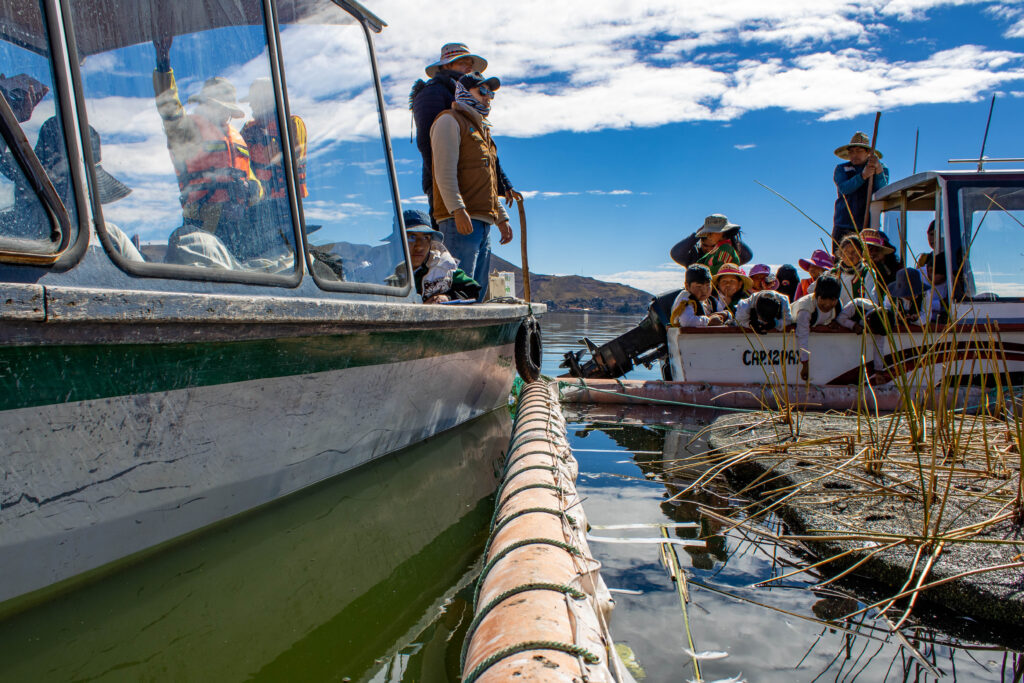
Biologist Dennys Arpasi explaining the monitoring process for floating green filters to students from Uros during a Citizen Science visit. (Photo: July 2026)
Q. Why do you think Lake Titicaca needs to be protected or restored?
From a primarily ecological perspective, I believe this lake must be protected because it is unique in the world. As its name suggests, it is the highest navigable lake in the world; it is home to a wide variety of endemic and native species that are unique to the region. So, in that sense, this lake also provides important ecosystem services to the lakeside communities living around Lake Titicaca.
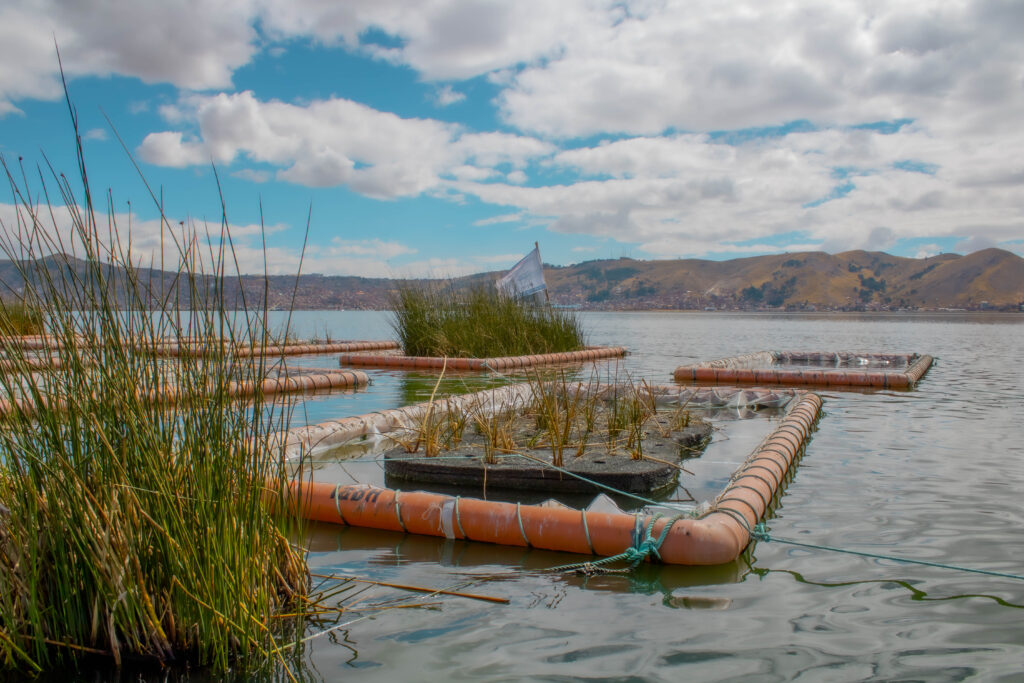
Pilot Project for Floating Green Filters in Puno's Inner Bay, Lake Titicaca. (Photo: July 2026)
These include ecological, social, economic, and cultural ecosystem services, which are very important to the populations of both Peru and Bolivia, since the lake is shared. And while it is true that the lake is currently facing environmental pressures due to pollution—both from wastewater in the cities near the lake and from tributary rivers that are steadily accumulating pollutants as they flow into Lake Titicaca—these pollutants, although currently limited to specific areas, could gradually spread and eventually affect the entire lake. Therefore, since many families depend on the lake, it is crucial for us to conduct research aimed at mitigating and halting this process.
So, it is extremely important, especially from an ecological standpoint, because these species I’ve already mentioned—which are native to the lake—are very important, and if they disappear, we will never see them again. So, there comes a point where we will reach a point of no return; that is why protecting Lake Titicaca is so important.
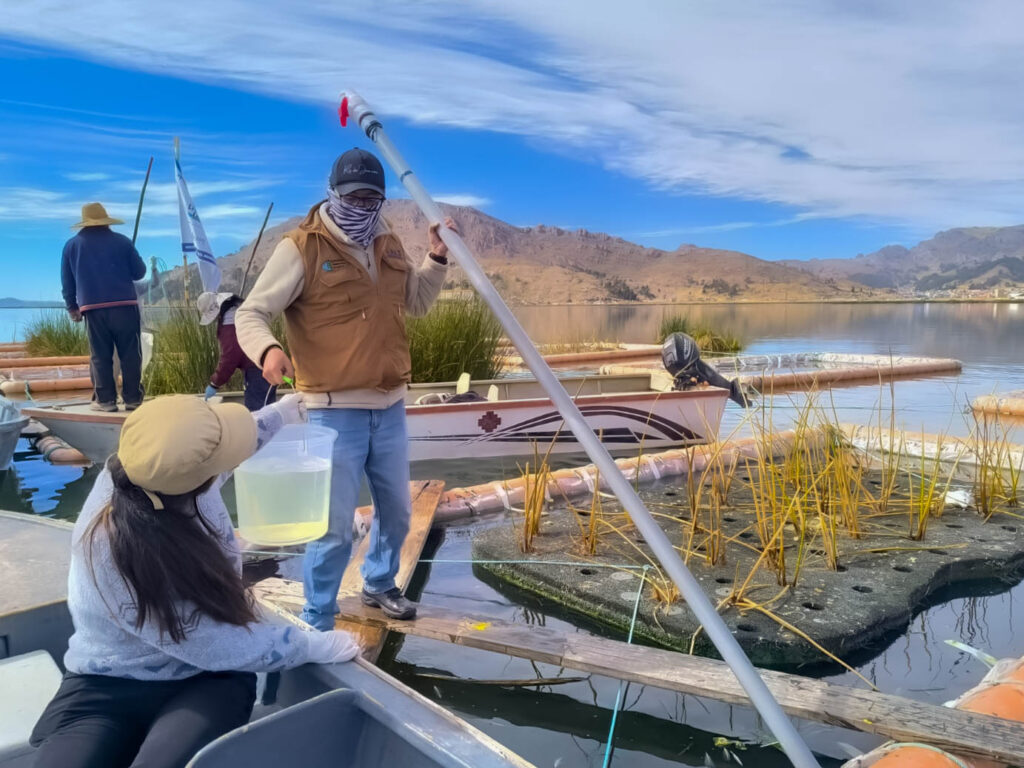
The ALT - Living Lakes team and partner organizations on a field trip to monitor the Floating Green Filters. (Photo: June 2026)
Q. What future do you imagine for Lake Titicaca?
What I aspire to as a professional is to see Lake Titicaca as a healthy lake, where those of us who live near the lake have environmental awareness and sensitivity; for the desire to protect it to come from within us and for us to become—as I’ve heard said—guardians of the lake.
It’s part of who we are to do our small part so that the lake can continue to be preserved in the future. So, my hope and vision for the future is that this will happen, and that the areas or sectors that are currently somewhat eutrophicated and/or experiencing high levels of eutrophication will become healthy again; and that water quality will be optimal for the species. And where aquaculture activities are still taking place, I hope they will adopt this sustainable development model.
And so, in this way, we can care for the lake and preserve it forever; it might be a bit of a stretch to say this, but it would be ideal for the ecosystem.
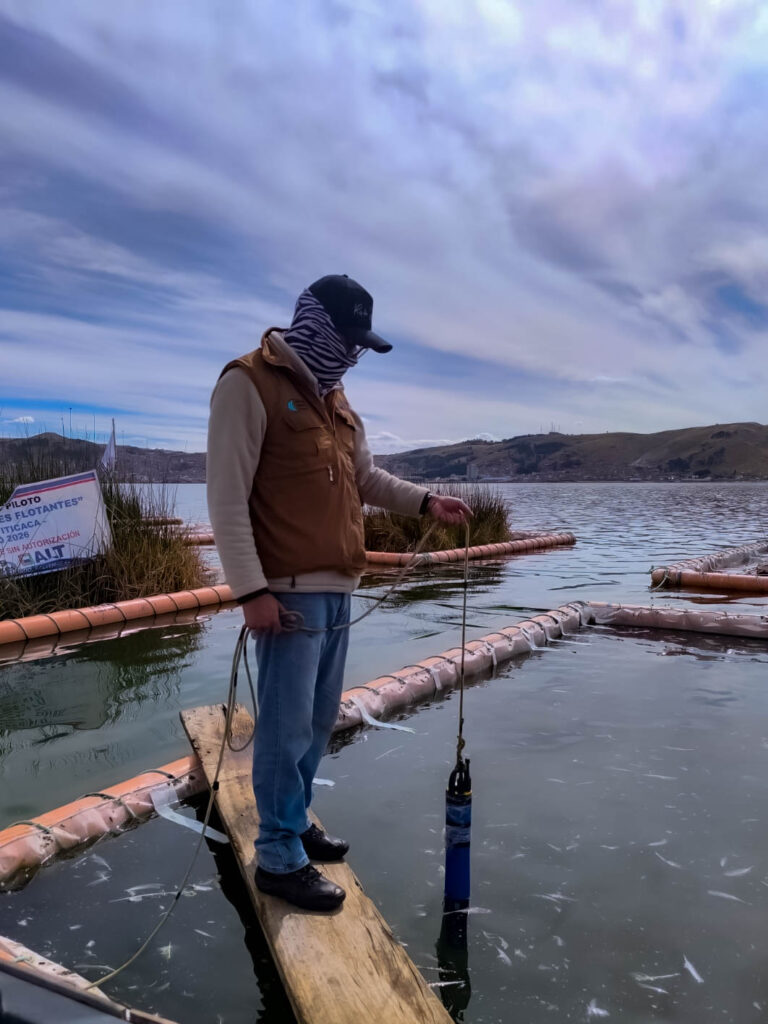
Biologist Dennys Arpasi operating the EXO2 equipment to measure water quality during the monitoring of the Floating Green Filters. (Photo: June 2026)
Join the global community for lakes
Sign up to receive our newsletter!
Thank you! Please check your inbox to complete your subscription
You are not suscribed yet - please check the confirmation email we just sent you. Thank you!
THIS WEBSITE USES COOKIES. We use cookies to store non-personal information necessary for the operation of the website. If you continue browsing the site, you accept the use of cookies on this website.